
News & Releases

Only citizens can vote. So why change the Constitution?
Our Kansas Constitution is the foundational law of our state. It should not be changed without a compelling reason and with clear intent.
The people have every right to amend their Constitution. But that does not mean every proposed change should be made. James Madison warned against unnecessarily multiplying constitutional experiments. George Washington cautioned against making constitutional changes based merely on “hypothesis and opinion.”
The burden should be on those proposing the change to explain what problem requires it and why altering the Constitution is the appropriate remedy.
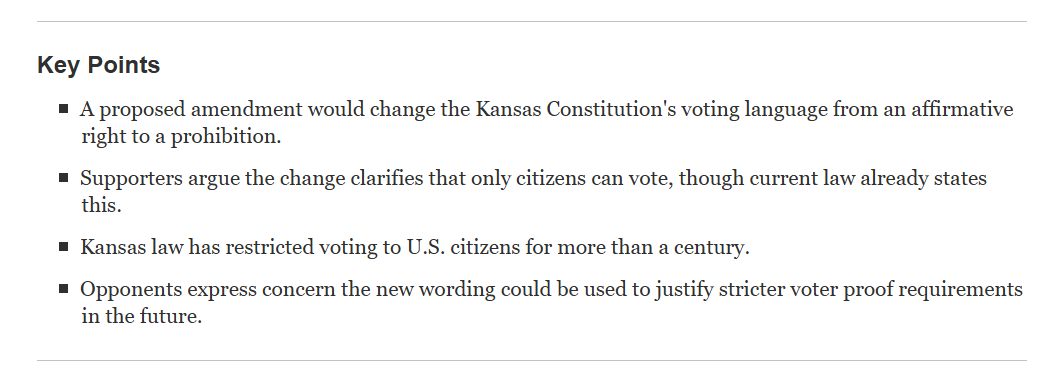
The proposed amendment on this fall’s ballot would change the language in our Constitution from the positive to the negative. Currently, it reads, “Every citizen of the United States who has attained the age of eighteen years and who resides in the voting area in which he or she seeks to vote shall be deemed a qualified elector.” The change would be to begin the section with “No person shall be deemed a qualified elector unless such person …”
At first reading it sounds like someone just playing with words and not changing the meaning, in which case, you really shouldn’t change the Constitution. But when a Constitution loses language clearly declaring that all citizens have the right to vote, that is a serious warning about what exactly is meant.
One answer is that supporters want to make it clear that only citizens can vote. However, the current language already says it is citizens who are eligible to vote. The language itself and its historical context are clear. Nothing in the current Constitution affirmatively authorizes noncitizen voting, and its history makes the intended meaning particularly clear.
The legislative history of the current language provides a great deal of clarity. The original Kansas Constitution actually did create two types of voters. There is the current language which then began with “First, citizens of the United States.” This was followed by a second section that added “Second, Persons of foreign birth who shall have declared their intention to become citizens …”
Noncitizens could vote in Kansas if they intended to become citizens. It was that way for about the first 57 years of our state.
This changed in 1917 and 1918 when Kansans decided that only citizens should be able to vote. The resolution introduced in the legislature to make that change was titled, “CONSTITUTIONAL AMENDMENT RELATING TO SUFFRAGE, AND ALLOWING ONLY CITIZENS OF THE UNITED STATES TO VOTE.”
Kansans overwhelmingly approved the change in 1918, by nearly 3 to 1.
The people who changed Kansas from a state permitting certain noncitizens to vote into a state allowing only citizens to vote believed “Every citizen …” accomplished exactly that. That language has governed Kansas elections for more than a century. Nothing needs to change to make that any clearer.
There is another reason to be cautious. Article V also directs the Legislature to provide “proper proofs of the right of suffrage.” Kansas has already had a long and expensive legal battle over a law requiring documentary proof of citizenship to register. The proposed amendment itself does not require a birth certificate, passport or other document.
But changing the constitutional qualification from an affirmative right to a prohibition raises a fair question about how that new wording might someday be read together with the Legislature’s power to require proof. Constitutions should not be rewritten when we cannot say confidently what the new language may be used to accomplish.
The right to vote is fundamental to all our other rights. It is how we as citizens declare our collective will. At a time when public confidence in elections is already strained, it is dangerous to change our constitutional voting language without an extraordinary reason. No such reason exists.
Only citizens can vote in Kansas. When you register, you declare under penalty of perjury that you are a citizen. Voting or attempting to vote as a noncitizen is a felony.
A constitution is not ordinary legislation, and we should not amend it merely because we can.
Scott Morgan is a Lawrence lawyer, former counsel to Sen. Bob Dole and Gov. Mike Hayden, former small-business owner and the United Kansas Party candidate for Kansas secretary of state.